
FAQ & Support
Answers to common lesson questions, teaching tips, and direct support for parents and tutors.
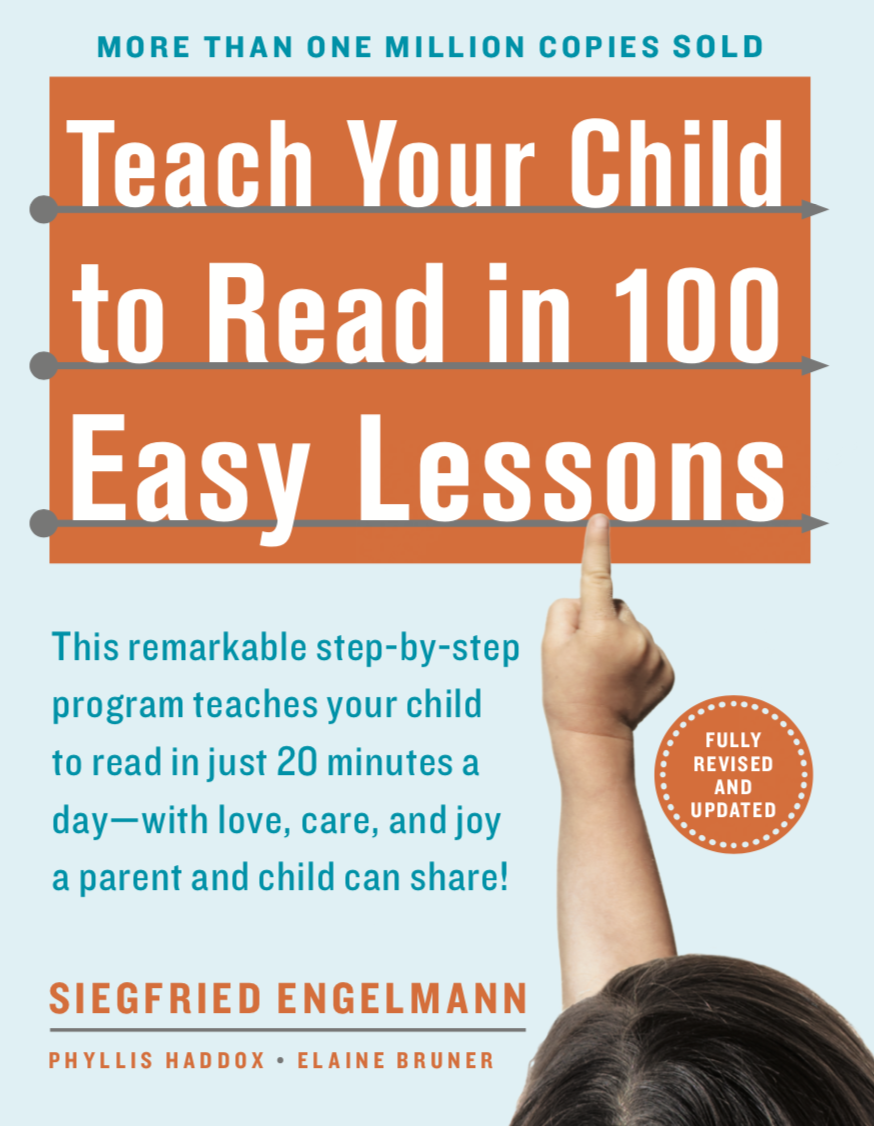
What age and skills does my child need to have before I begin using this book?
This book is an accelerated beginning reading program that was designed to teach four-year-old children and above either at home or in a tutorial program. It has also been successfully used with precocious three-year-old children. The authors recommend four prerequisite skills your child will need before beginning instruction. Your child should show an interest in learning to read; be able to listen, understand, and follow simple spoken English instructions; be able to speak in complete sentences, and sustain working on a task for more than a few minutes.
Does my child have to know the alphabet before I start teaching?
Children don’t have to know the alphabet letter names to read, they need to know sounds. This program teaches a child to identify and say the sounds. After the child has mastered the sounds, letter names are introduced in later lessons.
Why the “funny” print and it’s not in alphabet order?
The print (and all features of the program) is very purposefully designed to make learning to read as easy as possible. The sound-symbol introduction sequence was designed to maximize discrimination (symbols that look and sound different), helping children to learn and master more quickly. The sound-symbol introduction order was designed so children learn sounds that, when combined (blended), would produce the maximum number of words, which are then placed into stories as soon as possible.
Not only is the sequence different from alphabetic order, but most notably the configuration of the symbols is different:
 is taught since it is the symbol used most often in reading (books, online, forms, etc.) and “a” can easily be discriminated from d, p, q; while
 can easily be confused with d, p, and q by beginning readers. is used rarely in reading material, but is the handwriting version.
 and
 have different configurations of the oval part
 and
 have different stem lengths to make it easier to tell apart
Long vowels are shown with a macron (bar over symbol) to discriminate from short vowels.
Letters are combined that produce one sound: 
Only lowercase letters are taught (except the word I) so a child does not have to learn to identify both lowercase and uppercase at the beginning. Most words that we read are lowercase print. Capitals are introduced in later lessons. The book provides a transition to “regular” print later in the program.
How will my child understand the different sounds a letter makes, for example, the letter “a” makes different sounds in “rat,” “farm,” “fall,” “rain,” “late,” and “was?”
When letters are combined, they often make a different sound. The book’s instructional design accounts for these challenges. Sound-symbol combinations such as “ar,” “al,” “ai,” and silent “e” are also separated in the introduction and slowly integrated with previously learned sound-symbols to ensure understanding. For irregular words, words that do not follow common sound-symbol relationships, such as “was,” children learn that some words are “funny” because they are said differently than they are sounded out. Careful sequencing of the sound-symbol combinations and irregular words, plus sufficient practice, review, and strategic integration, sets children up for reading success.
Should I continue the lessons if my child does not remember the sounds?
Yes, continue the lessons while following these suggestions. When your child does not remember a sound, say the sound immediately, then ask, “What sound?” Return to the beginning of the exercise to see whether your child remembers, and make a big deal when your child remembers that “hard” sound. If your child does not remember the sound, repeat the correction procedure as needed while also encouraging your child (e.g., “Learning to read is hard work, but I know that you can do it!”). Review the difficult sound(s) at the end of the lesson and before beginning the next lesson.
Other suggestions include using the sound cards and sound-firming suggestions (under supplementary materials): https://startreading.com/videos-supplementary-material/.
You may want to teach only half a lesson until your child can complete a full lesson more easily. Although learning to read can be “hard,” make sure your child is still having fun through your praise and encouragement.
Will our regional dialect affect my child’s progress in learning to read?
Before considering regional differences, make sure you model sound production correctly. Please see the TYC Pronunciation Guide and the Sound-Symbol Relationships training video. Regional differences are often more prominent with vowel sounds in words. It is perfectly fine if you and your child read words the same way that you speak.
Should I begin teaching even though my child has speech or articulation difficulties?
Yes, your child can learn to read even with speech challenges. When a sound is difficult to pronounce, accept your child’s best approximation. Include extra practice with the difficult sound(s) before, during, and after a lesson, and praise your child for their hard work and best effort. Each time you include extra practice of a difficult sound, model its correct pronunciation. For example, if your child pronounces “www” for “rrr”. You can say, “Yes, rrr. Let’s see if you can say that tricky sound again.” You may also want to provide your child with spoken words (e.g., run) and sentences [e.g., (insert your child’s name) loves to run!] that contain that sound, so your child hears the sound used in the context of a word and sentence. TYC has been known to improve articulation for children with speech difficulties.
What if my child already knows sounds?
Start with lesson 1 and work through all six exercises to check that your child can pronounce sounds correctly and say continuous sounds for at least 3 seconds. Even though your child may know sounds, you should also be sure to check performance on the other pre-skills (blending–Saying the Sounds and Say It Fast exercises) taught in the lesson. If your child is proficient on all exercises, you may rapidly go through many lessons at a time using lots of encouragement and praise: “Wow, you went through that whole lesson in 5 minutes; you’re doing great! This is easy for you, so I bet you could zoom through another lesson. Let’s give it a try, OK?” Continue teaching lessons rapidly until you have used your allocated 15–20-minute period. Then teach and correct at an accelerated pace as time allows during the next periods. Once your child is challenged and makes errors (needs more corrections), teach at a regular rate. Always praise hard work and first-time correct responses, and stay positive during corrections.
How do I hold my child’s attention?
Children usually reflect the parent’s (or instructor’s) attitude. However, it is counterproductive to teach a child who is too young and does not want to learn to read. On the other hand, if your child asks to learn, you can start teaching a younger child. To stay actively engaged with your child during lessons, you must be very well practiced in following the scripted exercises and techniques BEFORE you teach so that you can present lessons quickly while also monitoring your child. This way, you can stay positive and animated in your interactions, which is especially important when your child makes errors. Always praise hard work and first-time correct responses and stay positive during corrections. You may also consider whether or not you want to offer, at the end of a teaching period, a tangible reward such as stickers, a stamp, or stars on a chart for working hard and/or completing a lesson.
Should I really teach for 20 minutes a day?
It’s always wise to base instructional decisions on the child’s responses and behavior. At the beginning of the program, the lessons are short and may not take 20 minutes to complete, but later lessons will take longer. If your child is becoming fatigued and inattentive after 20 minutes (or less), stop teaching and continue the next day with a short review, then complete the lesson. If your child is still working hard and enthusiastic after 20 minutes, take a break, then continue the lesson if your child really wants. Another option is to complete the lesson at a different time of the day. You may also split up a lesson and teach at two separate times during the day. You may also decide how many days a week to teach–it is not necessary to teach every day, but it is good to have a consistent schedule.
What techniques and strategies should I use to be successful using TYC?
The book was designed to teach one child. To set up for SUCCESS, follow these guidelines:
- Use a consistent schedule-20 minutes a day or split up time for a younger learner.
- Practice the sound-symbol relationships (see “Sound-Symbol Relationships Training Video” and the Sounds Pronunciation Guide of TYC)
- Learn about features of the scripted lessons
- Practice a lesson, including corrections before teaching a child.
(See demonstrations and training on the “Videos” page.) - Follow the script and bring it to life by presenting lessons with enthusiasm and naturally quick pacing to maintain attention.
(See demonstrations and training on the “Videos” page.) - Make sure the child can see the book or watch your mouth as indicated in the script.
- Use visual cues when the child is looking at the book (i.e., finger on the ball of the arrow, touch under each sound, or slash under each word).
- Monitor the child’s responses by watching fingers, mouth, and eyes.
- Express your personality with unscripted praise (e.g., good eyes on the book, great job sitting tall, fantastic job sounding out that word without stopping between the sounds).
- Correct errors immediately in a positive way by modeling the correct response, repeating the task with the child until the child is successful, and having the child repeat the task independently until firm.
- Confirm and reinforce working hard; specifically praise correct responses
- Utilize the Lesson Progress Chart to reward the child for completing the lesson.
How do I assist my child’s mastery of the words and stories?
During a lesson, do not hesitate to have your child repeat word-reading tasks. Make the extra practice FUN by challenging your child and saying, “Let’s start at the top and read the list of words one more time a little faster” or “Let’s go from the bottom of the list to the top to practice those hard words again.” For extra practice outside of the lessons, play word games with your child. See suggestions for firming words and playing word games. To make word cards, use the word list as they are presented in the lessons.
Dr. Haddox highly recommends the book series, Easy Readers–Teach Your Child to Read in 100 Easy Lessons Compatible Storybooks, by Ginger Burke. With feedback from Dr. Haddox, Ginger recently revised her books and added new features to further assist in teaching children: a New Words page and Notes to Parents/Teachers. Each book includes the corresponding TYC lesson to help parents choose the right book to ensure their children’s continued success in learning to read. The series starts with Book 1, used after a child successfully completes lesson 32 of TYC, and continues as a child progresses through TYC. Ginger’s books are clever, with cute content and illustrations. To purchase books, go to: https://www.teacherspayteachers.com/Store/The-Acorn-Place, then on the left side of her website homepage, under “CUSTOM CATEGORIES,” click on the link: Teach Your Child to Read in 100 Easy Lessons.
From Cove Books: another enthusiastic mom user of Teach Your Child to Read in 100 Easy Lessons developed a charming picture book series to supplement and correlate with the second edition of TYC. The first four books are the sad rat, sam the ram is sick, little tim had a wish, and the latest, Pat’s Hat. With feedback from Dr. Haddox, she included the scaffolding (arrows under words, dots under sounds, and “funny print”) as used in TYC to make reading easy for learners. Her books include teaching directions and word cards for every word used in each story. This is the link to her supplemental books: https://www.amazon.com/dp/B0BLYR63CV?binding=kindle_edition&ref=dbs_dp_rwt_sb_pc_tukn
Will instruction from TYC benefit my first or second grader who is still struggling in reading?
Virtually all children aged five and younger will benefit from instruction in Teach Your Child to Read in 100 Easy Lessons (TYC). To determine whether an older child will benefit from TYC instruction, have the child read aloud a story from TYC as you count errors. Understanding what determines an error and accurately counting errors matter because instruction should begin at an appropriate place—a lesson that is not too difficult nor too easy for the child. The first or second grade child will read “a rat is in a sack. that rat is not sad” from page 107 of the TYC book. You will mark one tally for each of the following errors the child makes:
- Says the sounds in a word but does not say the whole word fast (e.g., says “rrrrraaaaat” and not “rat.”)
- Does not know a word (e.g., sits silently when sees the word “rat;” (Note: wait three seconds and quickly provide the word)
- Misidentifies a word (e.g., says “the” instead of “a.”)
- Skips a word (e.g., does not say “is”)
Note: Self-corrections or rereading words are not counted as errors. Also, if the same error occurs twice, only count it as an error once.
Once you understand what determines an error, follow these procedures:
- Obtain a pencil, a paper to tally errors, and a paper to cover the story picture
- Identify a quiet location where you and the child can sit next to each other
- Open the TYC book to page 107 and cover the story picture
- Point to the first word of the story and tell the child, I want you to do your best reading this story out loud. Use your finger to point to each word as you are reading. If you do not know a word, that is OK! I will help you. For now, do your best.
Follow these guidelines to determine at which lesson to begin TYC instruction:
- Lesson 1 if the child makes more than 3 errors
- Lesson 13 if the child makes 3 errors
- Lesson 25 if the child makes 2 errors or less
A child who makes 2 errors or less may be able to read more challenging material than what is presented in Lesson 25. However, all children need to learn the foundational skills of saying sounds, sounding out words without stopping between sounds, quickly saying words, reading with expression, and connecting reading to meaning, which they will acquire if instruction is started at Lesson 25.
To ensure reading success for your first or second grader, please carefully examine the TYC 2.0 Practice Guide on page 14 with particular attention to the Expectations and Reinforcement (page 21), Corrections and Skill Mastery (pages 21-23), and Set Up for Success (pages 23-25) sections before beginning instruction. Of course, practice each lesson before you attempt to teach your child!
What should I do after TEACH YOUR CHILD TO READ IN 100 EASY LESSONS?
Your child has learned about the relationship between oral and written language—what words are and how they are formed. Your child understands that words have meaning and can respond orally. Your child does not need to rely on pictures to decode words or understand the story. However, you may have noticed that your child is not yet skilled at reading many larger words and irregular words. Your next instructional step should focus on teaching new words that contain sound combinations such as al, ee, and igh. In addition, introduce new reading material, but do so with care. Please refer to pages 393-395 in Teach Your Child to Read in 100 Easy Lessons for more detailed information.
How is the second edition of Teach Your Child to Read in 100 Easy Lessons (TYC 2.0) different from the first edition?
Although users of the original TYC will notice more differences than those listed below (e.g., a table of Contents, Acknowledgements, and Introduction), the following changes were made to maintain what was successful from the original and, at the same time, make teaching even smoother for the parent/user and ease learning for the child. The differences are categorized by where they are found in TYC 2.0 – in the beginning, within the lessons, and at the end of the book.
In the Beginning:
- NEW: “Overview” – new features of TYC 2.0; rationale for the Direct Instruction design and what skills are taught
- NEW: “Practice Guide” – rationale for techniques and strategies to learn before teaching lessons and exercises with examples to practice and key exercise checklists
- UPDATED: “Introduction of Program to Child”
Within the Lessons:
- UPDATED: more emphasis in exercises (rewording) on the important pre-reading skill of blending to lay the foundation for sounding out and saying words
- NEW: reading with expression to facilitate fluency (rather than slow and monotonous reading)
- UPDATED: Some stories and illustrations with improved characterizations
- REVISED: Starting at lesson 73, exercises were modified for a more seamless transition to traditional print, including the direct teaching of how a final “e” influences the vowel sound
At the End:
- EXPANDED: What to do after the 100 lessons with specific teaching exercises, vocabulary words, and a recommended book list
- NEW: “Supplemental Materials” – resources to support use during and after completing the 100 lessons
Any additional questions?
If you have a question that has not been addressed, please feel free to email Dr. Phyllis Haddox at teachyourchild100ez@gmail.com.